 Borg 2.0.0b26.dev13
Data structures and file formats
This page documents the internal data structures and storage mechanisms of Borg. It is partly based on mailing list discussions and also on static code analysis.
Repository
Borg stores its data in a Repository, which is a key-value store implemented
on top of borgstore (borgstore.store.Store, see repository.py).
Store object names are organised in namespaces, and borg uses these:
archives/, cache/, config/, index/, keys/, locks/ and
packs/.
Names within a namespace are flat, except for packs/: it is configured
with one nesting level, so a pack file’s name is prefixed with a directory
named after the first byte (2 hex digits) of the object name.
Several store objects are content-addressed: they are named by the store hash
of their content. The store hash is the unkeyed 256 bit BLAKE3 hash, see
store_hash() in crypto/key.py. It is the same for every repository and independent of the key/encryption mode
(unlike the chunk id hash, which the key mode selects).
- config/
- config
the repository config (see Repository config), a text object
- defaults
the repository defaults (see Repository defaults), in the key’s store object envelope (see below).
borg repo-createalways writes it.- space-reserve.N
purely random binary data to reserve space, e.g. for disk-full emergencies. These objects are created and removed by
borg repo-space.
There is one pointer object per archive in this namespace, its name is the hex-encoded archive ID (see Archives):
- archives/
0000… .. ffff…
The (encrypted and compressed) repository objects are not stored one store object each: many of them are batched into a pack file and that pack file is stored as a single store object. Its name is the hex-encoded store hash of the pack file’s content:
- packs/
- 00/ .. ff/
0000… .. ffff…
- index/
- 0000… .. ffff…
the chunks index (chunk ID -> location within a pack file), stored as a set of immutable index fragments, each in the key’s store object envelope (see below). A fragment’s name is the hex-encoded store hash of the stored envelope.
See Pack files for the pack file format, the index/ namespace and how
both are written and compacted.
- cache/
- checked-packs
repository check results (pack id -> timestamp, result), as a hashtable in the key’s store object envelope (see below). Records are kept across checks:
check --max-ageskips packs whose intact record is younger than the given age, and partial checks (--max-duration) verify the least-recently-checked packs first so repeated runs cover the whole repository. Records of corrupt packs are kept for repair and always re-verified. Records of packs no longer listed in packs/ are pruned when a check finishes.- referenced-by-archive.<hex-encoded archive ID>
what one archive references (object ID -> plaintext object size), plus the file count and content size of that archive, in the key’s store object envelope (see below). It lets a following
borg compactorborg analyzeskip re-reading the items of an unchanged archive.- chunkindex-invalid
a marker object: while it is present, the chunks index in
index/is considered invalid, because its fragments may be missing entries or point at deleted packs. It is written before deleting index fragments, before a single-object delete removes the old pack, and byborg check --repairafter storing packs, before it re-reads them and stores the index. It is removed after the last fragment is deleted or once the complete current index is stored.
Note that this cache/ namespace is inside the repository (and thus shared by
all clients); it is not the client-local cache described in
the files cache.
- keys/
When using repokey mode, the encrypted, passphrase protected borg keys are stored here as a base64 encoded text. The store hash of the stored borg key is used for the name.
A repository may contain multiple such borg keys (one per passphrase) to support the multiple borg keys feature. keyfile and repokey borg keys use the same format and naming (only the storage location differs).
- locks/
used by the locking system to manage shared and exclusive locks, see Locks (storelocking). The lock objects are stored in the store object envelope (see below).
The index fragments, the lock objects, checked-packs, the
referenced-by-archive.* objects and config/defaults are stored in the store object envelope: the repository key’s encrypt(),
exactly as for the metadata and data slots of the objects in a pack (see
Encryption), with an empty id and an AAD of
b"borg-store-object\0" followed by the repository id, the tag b"n" and the
object name. For the index fragments and the lock objects, whose name is the store hash
of the envelope and does not exist before it, the AAD holds the tag b"h" and the
namespace (index or locks) instead: the tags keep a namespace and an object of the same name apart. So these
objects are protected like the objects in the packs: encrypted and authenticated in
the encrypting modes, authenticated only in the authenticated-* modes. The AAD
binds an object to its repository and name: an object copied to another name, or
from another repository using the same key material, fails the authentication.
Reading or writing them needs the key (Repository.set_key()); an object that
fails the authentication is treated like a corrupted one: borg check reports a
corrupt index fragment and borg check --repair rebuilds the chunks index from the
packs; any other command that needs the chunks index aborts, except borg compact
and borg repo-compress, which rebuild it from the packs, as they rewrite the whole
chunks index anyway (under an exclusive lock). A corrupted cache is ignored and
rebuilt. A lock object that fails the authentication is treated as a foreign exclusive
lock, see Locks (storelocking). The commands that use config/defaults abort if it is
missing or fails the authentication, borg check --repair replaces it by empty defaults
(see Repository defaults). The chunkindex-invalid marker has no content and is
stored as is.
Keys
Repository object IDs (which are used as key into the key-value store) are byte strings of fixed length (256-bit, 32 bytes), computed like this:
key = id = id_hash(plaintext_data) # plain = not encrypted, not compressed, not obfuscated
For the encrypted modes (aes256-ocb, chacha20-poly1305), the id_hash
function is selected via borg repo-create --id-hash, independently of
--encryption. It is a keyed MAC over the plaintext (keyed by id_key):
sha256 selects HMAC-SHA256, blake3 selects a keyed BLAKE3.
For the modes without encryption (authenticated-sha256 /
authenticated-blake3), the id hash is what protects the data, so it is part
of the mode name and not separately selectable (giving --id-hash in addition
is only accepted if it agrees with the mode name). These modes have key material
and thus use the same keyed MACs as the encrypted modes, see Modes without encryption.
As the id / key is used for deduplication, id_hash must be a cryptographically strong hash or MAC.
Repository objects
Repository objects are not stored as separate store objects. Many of them are
written into one pack file, which is then stored as a single store object
below packs/. Where an object lives inside which pack is recorded in the
chunks index (see The chunks index), so reading one object is a single ranged read
from its pack file.
A repo object starts with a fixed-size, unencrypted header
(RepoObj.obj_header, a Struct("<8sB32sII"), 49 bytes), followed by the
metadata and the data:
magic, 8 bytes:
BORG_OBJformat version, 1 byte
chunk id, 32 bytes
meta size, 32-bit unsigned little-endian
data size, 32-bit unsigned little-endian
meta, meta size bytes
data, data size bytes
The overall size of repository objects varies from very small (a small source file will be stored as a single repository object) to medium (big source files will be cut into medium-sized chunks of some MB).
Metadata and data are separately encrypted and authenticated (depending on the user’s choices), with the header bound into the authentication as additional authenticated data. See Pack File Format for the details of the header, the authentication and how objects are laid out within a pack file.
See Encryption for a graphic outlining the anatomy of the encryption.
Repo object metadata
Metadata is a MessagePack-encoded (and encrypted/authenticated) dict with:
type (the repo object type, a one-character string:
Aarchive metadata,Carchive metadata stream chunk ids,Sarchive metadata stream chunk,Ffile content stream chunk - see theROBJ_*constants)ctype (compression type 0..255)
clevel (compression level, one byte, interpreted depending on ctype - see Compression)
csize (overall compressed (and maybe obfuscated) data size)
psize (only when obfuscated: payload size without the obfuscation trailer)
olevel (only when obfuscated: the obfuscation level)
size (uncompressed size of the data)
Having this separately encrypted metadata makes it more efficient to query the metadata without having to read, transfer and decrypt the (usually much bigger) data part.
The compression ctype and clevel is explained in Compression.
Compaction
borg compact is used to free repository space. It will:
get all object IDs (and where they are stored) from the chunks index
read all archives and determine which object IDs are in use
report object IDs used by archives, but not present in the repository (data loss!)
really delete the soft-deleted archives (unless objects are missing - then they are kept, so
borg undeletestays possible untilborg check --repairhas run)free space one pack file at a time - a single object can not be removed from a pack file, only a whole pack file can be deleted or rewritten:
a pack file whose indexed objects are all unused is deleted
a pack file with some unused objects is rewritten without them, but only if the wasted bytes reach the
--thresholdpercentagevery small pack files are merged into bigger ones
a pack file recorded corrupt by
borg checkis not rewritten or merged, it is only deleted if its indexed objects are all unused
update the chunks index in
index/accordinglywith
--stats, compute statistics about:compression and deduplication factors
repository space usage and space freed
The object graph
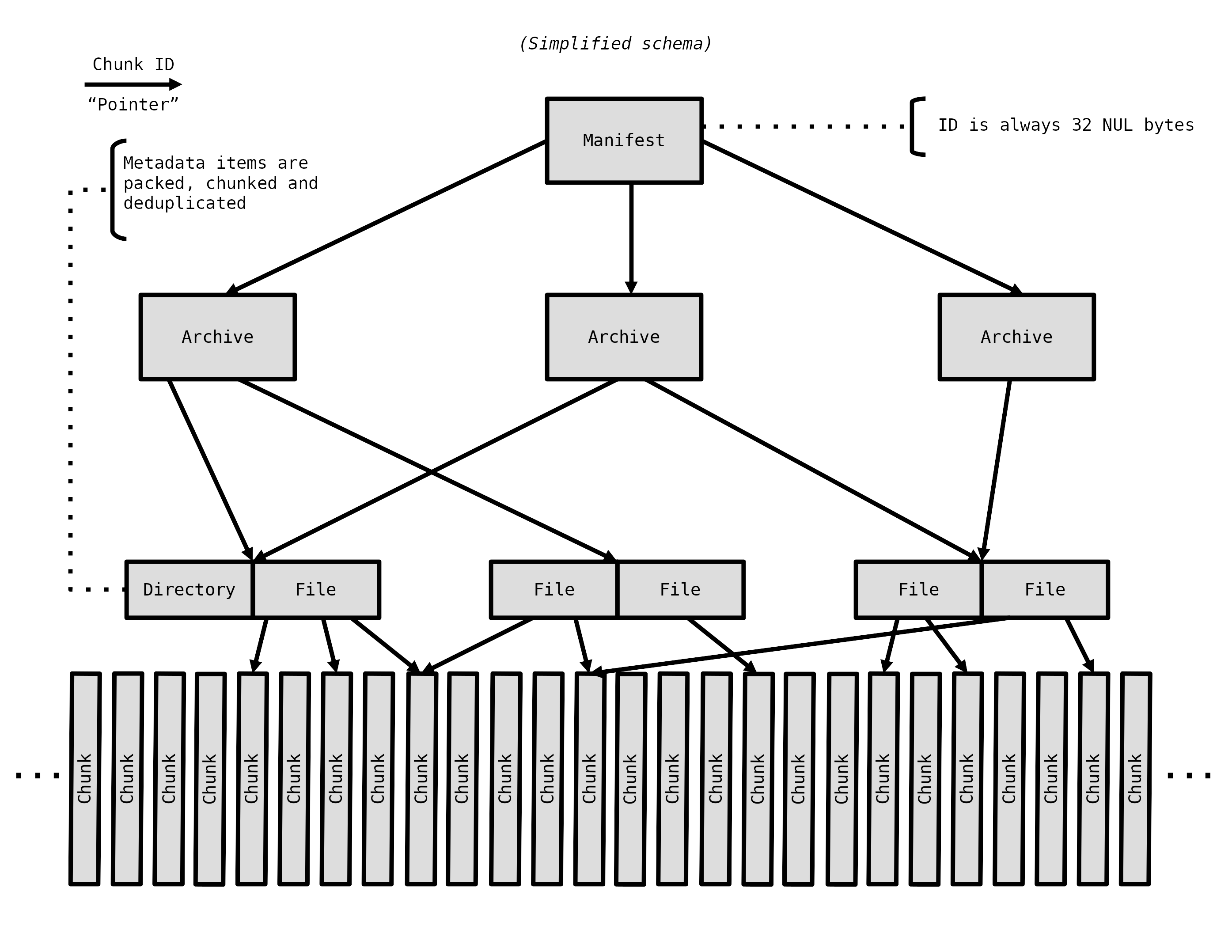
On top of the simple key-value store offered by the Repository, Borg builds a much more sophisticated data structure that is essentially a completely encrypted object graph. Objects, such as archives, are referenced by their chunk ID, which is cryptographically derived from their contents. More on how this helps security in Structural Authentication.
Repository config
The repository config is the config/config store object (see Repository), a
plain text INI-style file. It is the only object borg needs to read to open a
repository. It looks like this:
# This is a Borg Backup repository.
# See https://borgbackup.readthedocs.io/

[repository]
version = 5
id = 0a2744f216526be75ae14a5fa5b123127bb218558219f6203e09e4f220e45903
encryption = aes256-ocb
id_hash = sha256
version is the repository version. borg refuses to open a repository whose version it does not support (currently, only version 5 is supported).
id is the unique repository ID (32 bytes, hex encoded). It does not change if the repository is moved to another location. The keys of the repository are bound to it (see Key files), and the client’s cache and security directories are named after it.
encryption and id_hash record the crypto suite of the repository’s key, by
the same names borg repo-create --encryption and --id-hash accept. This
is how borg selects the key class when opening a repository, without reading any
repository object. The config is plaintext and not authenticated; see
Remote repository access security for what protects against a swapped crypto suite.
Where the key is stored (keyfile or repokey) is not recorded
here: that is a property of each individual key, see Key files. Both
entries are present, or none: a repository created via the Python API
(Repository.create()) without a key has none, it can be used as a key/value
store, but borg refuses to load a key for it.
borg repo-create writes the config once, after the key was created: writing
it is what makes the store a repository. It then writes an empty chunks index
(which needs the key), so the first use of the repository does not have to build
it by listing the packs. A store without the config (e.g. the leftover of
an interrupted borg repo-create) is not a repository: borg reports it as not
a valid repository, and borg repo-create refuses to create a repository in a
non-empty location, saying whether it found a repository config there.
borg repo-delete --force destroys such a store, provided it looks like a borg
store (it has the packs, archives, index and config namespaces, which
Repository.create() makes in advance), so that it can be removed without other
access to the storage.
The config is the one object borg check --repair can not restore. If a
repository lost or damaged its config, it can be recreated by hand: the version
is 5, the id is in the key (the BORG_KEY <id> header line of a keyfile or of
a keys/ object, see Key files), and the encryption mode and id hash
are what borg repo-create was given (the key type byte of any repository
object encodes them as well, see KeyType in constants.py).
Repository defaults
The config/defaults store object holds default values for command options,
as a msgpacked dict mapping the option name to its value, both as strings:
{"compression": "zstd,3", "chunker_params": "fastcdc,19,23,21,2"}
compression is the default compression spec (see borg help compression),
set by borg repo-create --compression. The commands with a --compression
option use it if no compression was given via the command line, the environment or
the default config file; without it, they use lz4.
chunker_params are the default chunker-params, set by
borg repo-create --chunker-params. borg create and borg import-tar use
them if no chunker params were given (in the same ways as above), borg recreate
and borg transfer for --chunker-params default; without them, the built-in
default chunker params are used.
Each entry is optional, a missing entry means that the repository has no default for it.
Unlike the repository config, which borg must read before it knows the key, the
defaults are stored in the store object envelope,
so they are authenticated: an attacker with write access to the storage can not
change them (e.g. remove an obfuscate compression) without being noticed.
borg repo-create always writes the object, also when no default was given (an
empty dict), so removing it is noticed as well: the commands that use the defaults
refuse to run if the object is missing or fails the authentication. borg check
reports such an object and borg check --repair replaces it by empty defaults, so
the repository can be used again (with the built-in defaults). Like the repository
config, the defaults themselves can not be restored.
Archives
Each archive is an object referenced by an entry below archives/ (see
Repository). Such an entry is named after the hex-encoded archive ID and has
empty content - the name is all the information it carries, because the
archive ID is the chunk ID of the archive object. Deleting an archive only
soft-deletes that entry (borgstore renames it, appending a .del
suffix), so borg undelete can bring it back until borg compact removes
it for good.
The archive object itself does not store any of the data contained in the archive it describes. Instead, it contains a list of chunks which form a msgpacked stream of items. The archive object itself further contains some metadata:
version, 2 for archives created by borg 2
name, the archive name. As the archives/* entry only encodes the archive ID, this is the only place the name is stored. When borg check finds an archive object that has no entry below archives/ (e.g. because the entry was lost), it recreates the missing entry - which needs the archive ID only.
item_ptrs, a list of “pointer chunk” IDs. Each “pointer chunk” contains a list of chunk IDs of item metadata.
command_line, the command line which was used to create the archive
hostname
username
cwd, the current working directory borg was invoked in
time is the nominal archive timestamp - usually the time the archive was started, but
--timestampoverrides it. start and end are the timestamps of when creating the archive actually started and finished.comment, a user-specified archive comment
tags, the list of the archive’s tags
chunker_params are the chunker-params used for creating the archive. This is used by borg recreate to determine whether a given archive needs rechunking.
size and nfiles, the total size and the count of the source files in the archive
recreate_command_line, the command line of the borg recreate run that produced this archive (only present in archives that went through
borg recreate;borg transfercarries it over)
Items
Each item represents a file, directory or other file system item and is stored as a
dictionary created by the Item class that contains:
path
chunks, the list of data chunks (size: count * ~40B)
size (only for items with a chunks list: the sum of the chunk sizes)
user
group
uid
gid
mode (item type + permissions)
target (for symlinks: the link target)
hlid (for hardlinks)
rdev (for device files)
inode (the inode number, used by the files cache)
mtime, atime, ctime, birthtime in nanoseconds
xattrs
acl_access, acl_default, acl_extended, acl_nfs4 (various OS-dependent fields)
bsdflags (BSD-style file flags)
digests, hash digests over the full content of a regular file, see Item digests
The full set of keys known to this borg version is ITEM_KEYS in
constants.py. It also contains some keys borg 2 does not write, but still
reads from borg 1.x archives (e.g. when transferring them): source (borg 1.x
symlink target, now: target), hardlink_master, chunks_healthy and part.
Keys not in that set are preserved as they are when an item is read and written
back (e.g. by borg check --repair), so an older borg version does not damage
items written by a newer one. borg check only requires the path and mtime
keys to be present in every item and warns about keys it does not know.
Item digests
If asked to (--digests ALGOS, e.g. --digests=blake3), borg create and
borg import-tar compute hash digests over the full content of each regular file
and store them in the item’s digests dict, mapping the hash algorithm name to
the digest, e.g. {"blake3": b"..."} (32 bytes / 256 bits for blake3). The digest
of the content is the same as the one an external tool like b3sum computes - in
contrast to the chunk ids, it does not depend on the chunker or on borg’s key.
The same algorithms are available as borg list format keys, and
borg list --format "{blake3}" uses a stored digest if the item has one (otherwise
it reads the file content to compute it).
Digests are off by default (--digests=none): the content is hashed while it is
read and processed anyway, mostly by a background thread (our hash implementations
release the GIL), so one hash algorithm usually does not make borg create slower
for bigger files - but many small files are hashed by the main thread, and several
algorithms are hashed one after the other, which the background thread may not be
able to hide.
Digests are not computed if borg does not read the full content of a file:
an unchanged file (the files cache knows it) is not read again - borg takes the digests from the files cache. Files that are already in the files cache without digests only get them when they are read again (that is, when they change), so changing
--digestsonly affects files that borg reads.the additional hard links to a file are not read again, they get the digests of the first one.
borg create --reuse-fromreuses chunks of a reference archive without reading them, so the resulting item does not have digests.
All items are serialized using msgpack and the resulting byte stream is fed into the same chunker algorithm as used for regular file data and turned into deduplicated chunks. The reference to these chunks is then added to the archive metadata. To achieve a finer granularity on this metadata stream, we use different chunker params for this chunker, which result in smaller chunks.
A chunk is stored as an object as well, of course.
Chunks
Borg has these chunkers (the default is “fastcdc”):
“fixed”: a simple, low cpu overhead, fixed blocksize chunker, optionally supporting a header block of different size.
“fastcdc”: variable, content-defined blocksize, uses the window-less, keyed Gear rolling hash (FastCDC); faster than buzhash, same deduplication.
“buzhash64”: similar to “buzhash”, but improved 64bit implementation
“buzhash”: variable, content-defined blocksize, uses a rolling hash computed by the Buzhash algorithm.
“toeplitz-aes”: like “rabin-aes”, but the universal hash is a tabulated LFSR/Toeplitz hash (secret 2 KiB table, fixed public polynomial); same speed as “rabin-aes” with the best collision bound of the three.
“rabin-aes”: variable, content-defined blocksize; a rolling Rabin fingerprint (secret polynomial) post-processed with AES-128, so the cut decision only depends on the AES output (“UHF-then-PRF” construction). Strongest available protection against chunk-size fingerprinting attacks.
“goldilocks-aes”: like “rabin-aes”, but the universal hash is a polynomial hash over the Goldilocks prime field (the reference construction of the underlying paper); about half the rabin-aes speed, mainly a comparison baseline.
All chunkers support sparse file processing (borg create --sparse): hole
ranges in the input file are then detected (via SEEK_HOLE/SEEK_DATA)
and seeked over instead of being read, processing their content as all-zero.
For some more general usage hints see also --chunker-params.
“fixed” chunker
The fixed chunker triggers (chunks) at even-spaced offsets, e.g. every 4MiB, producing chunks of same block size (the last chunk is not required to be full-size).
Optionally, it supports processing a differently sized “header” first, before it starts to cut chunks of the desired block size. The default is not to have a differently sized header.
borg create --chunker-params fixed,BLOCK_SIZE[,HEADER_SIZE]
BLOCK_SIZE: no default value, multiple of the system page size (usually 4096 bytes) recommended. E.g.: 4194304 would cut 4MiB sized chunks.
HEADER_SIZE: optional, defaults to 0 (no header).
“fastcdc” chunker
FastCDC content-defined chunker using the Gear rolling hash. Unlike buzhash it is window-less (each byte’s influence simply decays out of the hash), so its update is cheaper and it chunks noticeably faster, while producing the same deduplication and (with normalized chunking) the same chunk-size distribution.
Like “buzhash64”, the Gear table is cryptographically derived from secret key material, so chunk cut points are unpredictable without the key.
borg create --chunker-params fastcdc,CHUNK_MIN_EXP,CHUNK_MAX_EXP,HASH_MASK_BITS,NC_LEVEL
can be used to tune the chunker parameters, the default is:
CHUNK_MIN_EXP = 19 (minimum chunk size = 2^19 B = 512 kiB)
CHUNK_MAX_EXP = 23 (maximum chunk size = 2^23 B = 8 MiB)
HASH_MASK_BITS = 21 (target chunk size ~= 2^21 B = 2 MiB)
NC_LEVEL = 2 (normalized chunking level, 0 disables it)
There is no window size (Gear is window-less). Normalized chunking varies the cut-point mask around the target size, which tightens the chunk-size distribution and reduces clamping at the min./max. chunk size.
This is the default chunker (fastcdc,19,23,21,2), also used for the item
metadata stream (with a finer granularity, fastcdc,15,19,17,2).
“buzhash64” chunker
Similar to “buzhash”, but using 64bit wide hash values.
The buzhash table is cryptographically derived from secret key material.
These changes should improve resistance against attacks and also solve some of the issues of the original (32bit / XORed table) implementation.
“buzhash” chunker
The buzhash chunker triggers (chunks) when the last HASH_MASK_BITS bits of the hash are zero, producing chunks with a target size of 2^HASH_MASK_BITS bytes.
Buzhash is only used for cutting the chunks at places defined by the content, the buzhash value is not used as the deduplication criteria (we use a cryptographically strong hash/MAC over the chunk contents for this, the id_hash).
The idea of content-defined chunking is assigning every byte where a cut could be placed a hash. The hash is based on some number of bytes (the window size) before the byte in question. Chunks are cut where the hash satisfies some condition (usually “n numbers of trailing/leading zeroes”). This causes chunks to be cut in the same location relative to the file’s contents, even if bytes are inserted or removed before/after a cut, as long as the bytes within the window stay the same. This results in a high chance that a single cluster of changes to a file will only result in 1-2 new chunks, aiding deduplication.
Using normal hash functions this would be extremely slow,
requiring hashing approximately window size * file size bytes.
A rolling hash is used instead, which allows to add a new input byte and
compute a new hash as well as remove a previously added input byte
from the computed hash. This makes the cost of computing a hash for each
input byte largely independent of the window size.
Borg defines minimum and maximum chunk sizes (CHUNK_MIN_EXP and CHUNK_MAX_EXP, respectively) which narrows down where cuts may be made, greatly reducing the amount of data that is actually hashed for content-defined chunking.
borg create --chunker-params buzhash,CHUNK_MIN_EXP,CHUNK_MAX_EXP,HASH_MASK_BITS,HASH_WINDOW_SIZE
can be used to tune the chunker parameters, the usual values are:
CHUNK_MIN_EXP = 19 (minimum chunk size = 2^19 B = 512 kiB)
CHUNK_MAX_EXP = 23 (maximum chunk size = 2^23 B = 8 MiB)
HASH_MASK_BITS = 21 (target chunk size ~= 2^21 B = 2 MiB)
HASH_WINDOW_SIZE = 4095 [B] (0xFFF) (must be an odd number)
The buzhash table is altered by XORing it with a seed randomly generated once for the repository, and stored encrypted in the keyfile. This is to prevent chunk size based fingerprinting attacks on your encrypted repo contents (to guess what files you have based on a specific set of chunk sizes).
“toeplitz-aes” chunker
Like “rabin-aes”, but the universal hash is a tabulated LFSR-based Toeplitz hash (Krawczyk, CRYPTO ‘94): the digest of the 64-byte window is sum_j x^(63-j) * T[b_j] over GF(2)[x] mod P, where T is a secret random table of 256 64-bit values (2 KiB of key material) and P is a fixed public irreducible polynomial of degree 64. The AES-128 PRF layer is the same as for “rabin-aes”. Two distinct windows collide with probability exactly 2^-64 over the choice of T - the best possible bound for a 64-bit digest, and unconditional (no secret polynomial sampling). The rolling update contains no secret-dependent memory access. Speed is on par with “rabin-aes”. See Chunkers for a comparison of all chunkers.
borg create --chunker-params toeplitz-aes,CHUNK_MIN_EXP,CHUNK_MAX_EXP,HASH_MASK_BITS,NC_LEVEL
The window size is fixed at 64 bytes. NC_LEVEL is the normalized chunking
level (0 disables it); 2 is a good default. E.g.: toeplitz-aes,19,23,21,2.
“rabin-aes” chunker
A “UHF-then-PRF” content-defined chunker, following the provably secure construction of Breaking and Fixing Content-Defined Chunking (Truong et al., 2025): a rolling Rabin fingerprint over GF(2)[x]/P(x) - with P a secret, random, irreducible polynomial of degree 64 - compresses the last 64 bytes into a digest (a universal hash), and AES-128 with a secret key is applied to that digest. The cut decision only looks at the AES output, so observed chunk boundaries are pseudo-random and do not provide usable equations about the chunking secrets, unlike chunkers that cut directly on (keyed) rolling hash bits. Both secrets are derived from the repository key material.
This is the recommended chunker when resistance against chunk-size fingerprinting attacks matters most. It is slower than “fastcdc” (one AES block encryption per scanned byte), but still fast in absolute terms: the implementation batches the AES work through OpenSSL or uses AES hardware instructions (arm64 crypto extensions / x86-64 AES-NI) where available.
borg create --chunker-params rabin-aes,CHUNK_MIN_EXP,CHUNK_MAX_EXP,HASH_MASK_BITS,NC_LEVEL
The window size is fixed at 64 bytes. NC_LEVEL is the normalized chunking
level (0 disables it); 2 is a good default. E.g.: rabin-aes,19,23,21,2.
“goldilocks-aes” chunker
Like “rabin-aes”, but the universal hash is the reference construction of the same paper: a polynomial hash over the Goldilocks prime field GF(p) with p = 2^64 - 2^32 + 1, evaluated at a secret random point K over the same 64-byte window. The AES-128 PRF layer and the security properties are the same as for “rabin-aes” (the two-window collision bound is even slightly better). It is about half as fast as “rabin-aes” - prime-field multiplies instead of table lookups in the rolling hash - and is provided mainly as a well-understood comparison baseline.
borg create --chunker-params goldilocks-aes,CHUNK_MIN_EXP,CHUNK_MAX_EXP,HASH_MASK_BITS,NC_LEVEL
The window size is fixed at 64 bytes. NC_LEVEL is the normalized chunking
level (0 disables it); 2 is a good default. E.g.: goldilocks-aes,19,23,21,2.
The files cache
The files cache is a client-local file, stored in the borg cache directory
of the repository (see Environment Variables) as files.<SUFFIX>. SUFFIX is the
store hash of the archive (series) name, so each archive series gets its own files
cache; BORG_FILES_CACHE_SUFFIX overrides it. The files cache is used at
backup time to quickly determine whether a given file is unchanged and we have
all its chunks.
In memory, the files cache is a key -> value mapping (a Python dict) and contains:
key: id_hash of the encoded path (same path as seen in archive)
value (
FileCacheEntryincache.py):age (0 [newest], …, BORG_FILES_CACHE_TTL - 1)
file inode number
file size
file ctime_ns
file mtime_ns
list of chunk (id, size) tuples representing the file’s contents
digests, the file’s content digests (see Item digests) or None
To determine whether a file has not changed, cached values are looked up via the key in the mapping and compared to the current file attribute values.
If the file’s size, timestamp and inode number is still the same, it is considered not to have changed. In that case, we check that all file content chunks are (still) present in the repository (we check that via the chunks cache).
If everything is matching and all chunks are present, the file is not read / chunked / hashed again (but still a file metadata item is written to the archive, made from fresh file metadata read from the filesystem). This is what makes borg so fast when processing unchanged files.
If there is a mismatch or a chunk is missing, the file is read / chunked / hashed. Chunks already present in repo won’t be transferred to repo again.
The inode number is stored and compared to make sure we distinguish between different files, as a single path may not be unique across different archives in different setups.
Not all filesystems have stable inode numbers. If that is the case, borg can be told to ignore the inode number in the check via --files-cache.
The age value is used for cache management. If a file is “seen” in a backup run, its age is reset to 0, otherwise its age is incremented by one. If a file was not seen in BORG_FILES_CACHE_TTL backups, its cache entry is removed.
The files cache is a python dictionary. To keep the memory overhead of python objects low, the value is not kept as a python tuple, but in a “compressed” form:
the chunks list is reduced from (256bit chunk id, 32bit size) tuples to bare 32bit indexes into the chunks index (see
ChunkIndex.k_to_idx). The chunk id and size are looked up from the chunks index again when the entry is used. This only works while that chunks index is in memory.the resulting entry is then msgpacked, so one dict value is a single
bytesobject instead of a nested structure of python objects.
Borg can also work without using the files cache (saves memory if you have a lot of files or not much RAM free), then all files are assumed to have changed. This is usually much slower than with files cache.
The on-disk format of the files cache is a stream of msgpacked tuples (key, value). There, the chunks list is stored in its uncompressed form (chunk id and size), as the chunks index indexes are only valid for one specific in-memory chunks index. Loading the files cache involves reading the file, one msgpack object at a time, unpacking it, and compressing the entry as described above.
The chunks index
The chunks index is persisted in the repository as index fragments and loaded in memory. It is used to determine whether we already have a specific chunk.
The chunks index is a key -> value mapping and contains:
key (32 bytes):
chunk id_hash
value (48 bytes,
ChunkIndexEntryinborg.hashindex):flags (32bit):
F_USED(chunk is used / referenced),F_COMPRESS(chunk shall get re-compressed),F_PENDING(the chunk is still buffered in the pack writer, so its pack location is not resolved yet). The upper 8 bits are reserved for system flags (currentlyF_NEW) and are not visible to users of the index.size (32bit): plaintext chunk size, 0 if not known (see below)
pack_id (32 bytes): id of the pack file the chunk’s blob is stored in
obj_offset (32bit): byte offset of the blob inside that pack file
obj_size (32bit): blob length (header + encrypted_meta + encrypted_data)
The last 3 values are the chunk’s location, see Pack Index Entry: reading a
chunk is one ranged read of [obj_offset, obj_offset + obj_size) from
packs/<hex(pack_id)>.
So a chunks index entry is 32 + 48 == 80 bytes, and that is also exactly what it needs on disk (the serialized format is just key/value pairs, no padding, plus a small header). In memory, there is some additional overhead, see below.
Not all of that is persisted, though: when an index fragment is written, flags and size are zeroed (only the chunk id and the pack location are of interest there). Thus, a chunks index that was just built from the repository has size == 0 for all its entries, no matter whether it came from the index fragments or from the slow rebuild (which reads the pack headers, where only the stored blob size is known, not the plaintext size).
The plaintext size of an entry is only filled in while borg is running, for the
chunks it actually processes: by borg create when it adds or re-uses a chunk,
or when the files cache entries of a previous archive are loaded (their chunks
lists have the plaintext sizes). So code using the chunks index must be prepared
to see size == 0 and must not assume it is the real chunk size.
The chunks index is a HashIndex.
Indexes / Caches memory usage
Here is the estimated memory usage of Borg - it’s complicated:
chunk_size ~= 2 ^ HASH_MASK_BITS  (content-defined chunkers, BLOCK_SIZE for fixed chunker)
chunk_count ~= total_file_size / chunk_size

chunks_index_usage = chunk_count * 100

files_cache_usage = total_file_count * 230 + chunk_count * 6

mem_usage ~= chunks_index_usage + files_cache_usage
           = chunk_count * 106 + total_file_count * 230
All units are Bytes.
The 100 Bytes per chunks index entry are the 80 Bytes of the entry itself plus the overhead of the hash table it lives in (see HashIndex): the keys/values arrays are over-allocated by up to 30%, and the bucket table adds another 4 Bytes per bucket at a load factor of 0.25 .. 0.5. So, depending on where between two resizes the index currently is, the real value is somewhere between 88 and 120 Bytes per entry - 100 is a good average.
The files cache numbers are for CPython on a 64bit platform: the ~230 Bytes per file
cover the dict slot, the 32 Bytes path hash (as a python bytes object) and the
fixed part of the msgpacked value; the ~6 Bytes per chunk are one msgpacked 32bit
index into the chunks index.
Both data structures grow by re-allocating and copying, so there are short-time peaks in memory usage while a resize happens (worst case about 2x the values computed above for the structure being resized). Usually this does not happen for all data structures at the same time, though.
It is assuming every chunk is referenced exactly once (if you have a lot of duplicate chunks, you will have fewer chunks than estimated above).
It is also assuming that typical chunk size is 2^HASH_MASK_BITS (if you have a lot of files smaller than this statistical medium chunk size, you will have more chunks than estimated above, because 1 file is at least 1 chunk).
The chunks index and files cache are both implemented as hash tables (the chunks index as a HashIndex, the files cache as a python dict). A hash table must have a significant amount of unused entries to be fast - the so-called load factor gives the used/unused elements ratio.
E.g. backing up a total count of 1 Mi (IEC binary prefix i.e. 2^20) files with a total size of 1TiB.
with
create --chunker-params fastcdc,10,23,16,2(custom):
chunk_count = 16 Mi, chunks_index_usage = 1.56GiB, files_cache_usage = 0.32GiB
mem_usage = 1.9GiB
with
create --chunker-params fastcdc,19,23,21,2(default):
chunk_count = 512 Ki, chunks_index_usage = 0.05GiB, files_cache_usage = 0.23GiB
mem_usage = 0.28GiB
Note
There is also the --files-cache=disabled option to disable the files cache.
You’ll save some memory, but it will need to read / chunk all the files as
it can not skip unmodified files then.
HashIndex
The chunks index is implemented on top of borghash.HashTableNT, which comes from
the separate borghash package (Cython).
borg.hashindex.ChunkIndex only adds the borg specific parts on top of it: the
ChunkIndexEntry namedtuple / struct format and the handling of the system flags.
HashTableNT packs/unpacks the namedtuple value to/from bytes using a
struct.Struct and delegates the actual storage to borghash.HashTable, which
is a fixed key size / fixed value size bytes -> bytes mapping.
Internally, HashTable is not one, but three arrays:
the bucket table, an array of
uint32_tindexes into the keys/values arrays.0xffffffffmarks an empty bucket,0xfffffffemarks a deleted bucket (tombstone); everything>= 0xffffff00is reserved, so the usable index range (and thus the maximum number of entries) is a bit below 4Gi.the keys array, holding
key_size(32 for the chunks index) Bytes per entry.the values array, holding
value_size(48 for the chunks index) Bytes per entry.
Keys and values are appended to their arrays in insertion order, so the index of a
key in the keys array is stable while the hash table is in memory. The files cache
uses that to “compress” chunk ids to 32bit numbers, see ChunkIndex.k_to_idx.
The bucket table has only one slot per bucket, spreading hash collisions to the following buckets. As a consequence the hash is just a start position for a linear search. If a key is looked up that is not in the table, then the bucket table is searched from the start position (the hash) until the first empty bucket is reached.
This particular mode of operation is open addressing with linear probing.
The bucket table is grown (by 2x) when the number of used buckets plus tombstones exceeds 50% of its capacity, and shrunken (to 40%, but never below 1000 buckets) when the number of used buckets drops below 10% of its capacity. So its load factor usually is between 0.25 and 0.5. That is cheap, because a bucket is only 4 Bytes - the bulk of the data is in the keys/values arrays, which are not hash tables and thus do not need any unused space for speed. They are just grown by 1.3x whenever they are full.
If an element is deleted, its bucket is marked with a tombstone (the keys/values array slots are zeroed, but not reclaimed until the next rebuild). Tombstones are only removed by resizing / rebuilding the bucket table. They present the same load to the hash table as a real entry (recall that linear probing for an element not in the index stops at the first empty bucket), which is why they count towards the load factor that triggers the growth.
Data in a HashIndex is stored in little-endian format, which increases efficiency for almost everyone, since basically no one uses big-endian processors any more.
HashIndex does not use a hashing function, because all keys are outputs of a cryptographic hash or MAC and thus already have excellent distribution. Thus, HashIndex simply uses the first 32 bits of the key as its “hash”.
The on-disk format does not mirror the in-memory layout - neither the bucket table nor the unused space of the keys/values arrays are written. A serialized HashIndex is:
First, a header: the eight byte ASCII string “BORGHASH”, an
uint32format version and anuint32length of the metadata block (all little-endian).Second, the metadata block, a JSON object with the key size, value size, byte order, the value namedtuple’s name / fields / struct format, the bucket table capacity and the number of entries (“used”).
Third, “used” times a (key, value) pair, without any padding or separators.
So the on-disk size is entries * (key_size + value_size) plus a small header,
i.e. exactly 80 Bytes per entry for the chunks index.
Encryption
See also
The Cryptography in Borg section for an in-depth review.
AEAD modes
For new repositories, borg only uses modern AEAD ciphers: AES-OCB or CHACHA20-POLY1305.
For each borg invocation, a new sessionkey is derived from the borg key material and the 48bit IV starts from 0 again. The cipher blocks of a chunk do not consume IVs here (CHACHA20-POLY1305 counts them in its internal 32bit block counter, AES-OCB derives the per-block offsets from the IV), so we just count up by 1 per chunk.
The encryption layout is best seen at the bottom of this diagram:
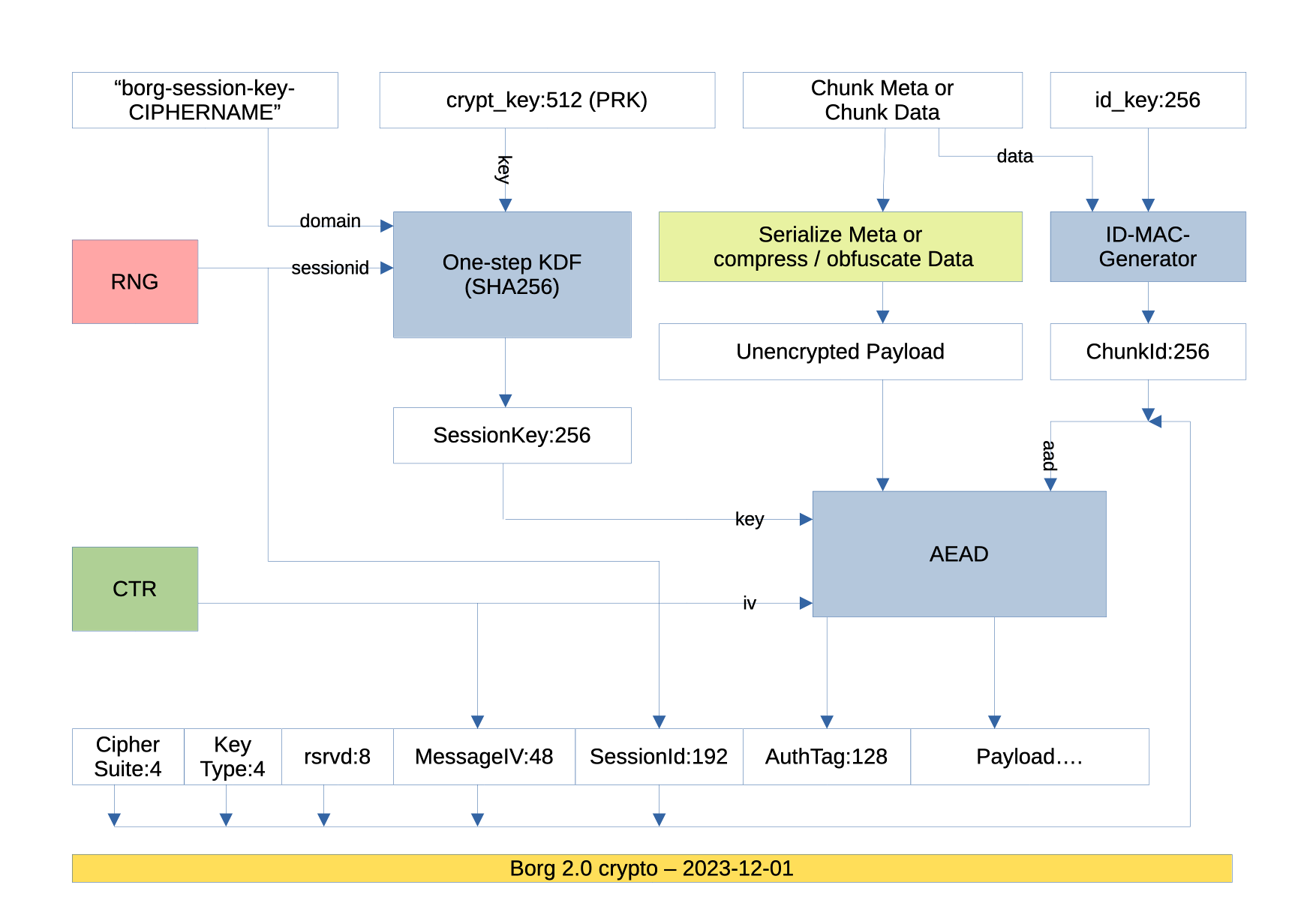
No special IV/counter management is needed here due to the use of session keys.
The 48 bit IV limits the number of messages (chunks and metadata objects) that we encrypt with one session key to 2^48 - borg refuses to encrypt more rather than reusing an IV. That is way more than needed: even if you only backed up 4kiB chunks (2^12B), 2^48 messages would be 2^(12+48)B == 1.2 exabytes of input data, meaning you would run against other limitations (RAM, storage, time) way before that.
How much data we may encrypt with one session key is a different question, which is not answered by the IV size, but by the security bounds of the ciphers, see below.
AEAD usage limits
The relevant quantities are the number of encrypted messages (q), the amount of data
encrypted with one key and the number of forgery attempts (v, decryptions of tampered
data that borg refuses). p is the attacker’s success probability we still consider
acceptable. See issue #6501 for the details and for the computations.
Number of messages (both ciphers): limited to 2^48 per session key by the IV size, see above. This is never the binding limit for either cipher.
Data volume (AES-OCB): the attacker’s advantage grows with the square of the amount of data encrypted using one key: about
6 * sigma^2 / 2^128,sigmabeing the number of 128bit cipher blocks, including the authenticated header. RFC 7253 derives from this bound that one key should encrypt at most 2^48 blocks (4PiB), which corresponds to p == 2^-32. borg aims higher and starts a new session after 2^37 blocks (2TiB), which corresponds to p == 2^-51 per session key.CHACHA20-POLY1305 does not have such a limit at all: its confidentiality bound does not depend on the amount of data encrypted.
Forgery attempts (CHACHA20-POLY1305):
v <= p * 2^103 / (L' + 1),L'being the message length (payload plus authenticated header) in 128bit blocks. For borg’s biggest messages, that is about 2^33 forgery attempts at p == 2^-50, so an attacker would have to make borg read more than 100PiB of tampered data. Note that this is counted over all session keys, so - unlike the data volume limit - it can not be improved by starting more sessions.For AES-OCB, the corresponding limit is much higher (its 128bit authentication tag gives a term in the order of
v * L / 2^128), so the CHACHA20-POLY1305 limit is the one to look at.
We do not count or enforce the forgery attempts limit, we just document it here:
a failed decryption means we got tampered or corrupted data and borg refuses it, usually
aborting the whole command (borg check and archive listing keep going, but only to
report the damage). Getting anywhere near the limit computed above would require feeding
borg a lot more tampered data than any real repository will ever hold.
Starting a new session just means computing a new random session id and deriving a new session key from it (and counting the IV from 0 again). That is cheap and it does not need any special handling when reading, because the session id is part of every chunk header. Because the advantages of the individual session keys just add up, frequent session key changes also keep the total advantage low over the lifetime of a borg key.
Modes without encryption
The authenticated-* modes do not encrypt: the payload of a repository
object slot (the compressed chunk data resp. the packed metadata, see Repository objects)
is stored as-is. Every slot still carries a 32 byte tag:
TYPE(1) + reserved(1) + tag(32) + payload
TYPE is the key type byte (which identifies the mode, see KeyType), reserved is
zero. The tag is computed over the envelope header, the AAD and the payload:
aad_full = aad + chunk_id
tag = MAC(tag_key, TYPE || reserved || len16_be(aad_full) || aad_full || payload)
aad is what RepoObj authenticates alongside the payload: the object header prefix
(magic, format version, chunk id) and the slot tag (M for meta, D for data), see
Pack File Format. Consequently, the tag detects modification of the payload, of the
metadata, of the object header, a swap of the meta and the data slot, and an object slice
taken from a different object. The length prefix keeps the boundary between the AAD and the
payload unambiguous.
There is no nonce, no session and no other state: the tag is deterministic. Two repositories with the same key material therefore store byte-identical objects for identical input, which allows deduplicating them on the filesystem level (e.g. with CoW/dedup tools).
The tag is a MAC (HMAC-SHA256 for authenticated-sha256, keyed BLAKE3 for
authenticated-blake3), so only somebody who has the borg key can compute it - this detects
malicious tampering, not just accidental corruption. The MAC key is derived from crypt_key:
tag_key = sha256(crypt_key + b"borg-repoobj-mac-hmac-sha256")[:32]   # authenticated-sha256
tag_key = sha256(crypt_key + b"borg-repoobj-mac-blake3")[:32]        # authenticated-blake3
It is deliberately not derived from id_key: chunk ids are public, and related repositories
share the id key (see borg repo-create --other-repo), which must not enable them to forge
each other’s objects. --copy-crypt-key shares crypt_key and thus opts into producing
byte-identical objects across the related repositories.
Legacy modes
Old repositories (which used AES-CTR mode) are supported read-only to be able to
borg transfer their archives to new repositories (which use AEAD modes).
AES-CTR mode is not supported for new repositories and the related code will be removed in a future release.
The same applies to the borg 1.x none and authenticated modes: their envelope is just
the type byte followed by the payload, so nothing about an object is verified except the chunk
id over the plaintext. borg 2 has no none mode, and its authenticated-* modes use the
tagged envelope described above.
All modes
Encryption keys (and other secrets) are kept either in the keys directory on the client (‘keyfile’ mode) or under the keys/ namespace in the repository (‘repokey’ mode) using the store hash of the borg key content as the name.
In both cases, the secrets are generated from random and then encrypted by a key derived from your passphrase (this happens on the client before the key is stored as keyfile or repokey).
keyfile and repokey borg keys use the same format; only the storage location differs. Borg finds the correct key by trying each key against the supplied passphrase. See Multiple borg keys.
The passphrase is passed through the BORG_PASSPHRASE environment variable
or prompted for interactive usage.
Key files
See also
The Offline key security section for an in-depth review of the key encryption.
When initializing a repository with one of the “keyfile” encryption modes, Borg creates an associated key file in the keys subdirectory of the borg config directory (see Environment Variables for platform-specific default paths).
The same key is also used in the “repokey” modes, which store it in the repository.
The internal data structure is as follows:
- version
currently always an integer, 2
- repository_id
the repository ID, as stored in the repository config (see Repository config).
- crypt_key
the initial key material used for the AEAD crypto (512 bits)
- id_key
the key used to MAC the plaintext chunk data to compute the chunk’s id. The content-defined chunkers other than “buzhash” also derive their secret (table, polynomial, AES key) from it, each using its own domain.
- chunk_seed
the seed for the buzhash chunking table (signed 32 bit integer), only used by the “buzhash” chunker
These fields are packed using msgpack. The utf-8 encoded passphrase is processed with argon2 to derive a 256 bit key encryption key (KEK).
Then the KEK is used to encrypt and authenticate the packed data using the chacha20-poly1305 AEAD cipher.
The result is stored in a another msgpack formatted as follows:
- version
currently always an integer, 1
- salt
random 128 bits (
ARGON2_SALT_BYTES== 16) salt used to process the passphrase- argon2_*
some parameters for the argon2 kdf
- algorithm
the algorithms used to process the passphrase (currently the string
argon2 chacha20-poly1305)- data
The encrypted, packed fields.
- label
optional: a human-readable label for this borg key, e.g.
adminfor the borg key created byborg repo-create. See multiple borg keys.
The resulting msgpack is then encoded using base64 and written to the
key file, wrapped using the standard textwrap module with a header.
The header is a single line with a MAGIC string, a space and a hexadecimal
representation of the repository id.
Compression
Borg supports the following compression methods, each identified by a ctype value in the range between 0 and 255 (and augmented by a one-byte clevel value for the compression level):
none (no compression, pass through data 1:1), identified by 0x00
lz4 (low compression, but super fast), identified by 0x01
zstd (level -128..22 offering a wide range: level 22 is higher compression and lower speed, level 1 is lower compression and high speed, and the negative “fast” levels trade still more compression for still more speed) - identified by 0x03
zlib (level 0-9, level 0 is no compression [but still adding zlib overhead], level 1 is low, level 9 is high compression), identified by 0x05
lzma (level 0-9, level 0 is low, level 9 is high compression), identified by 0x02.
The type byte is followed by a byte indicating the compression level. How that byte is
interpreted depends on the compression type: for zstd it is an int8_t, so that the
negative levels fit (level -1 is stored as 255, -128 as 128). For all other types it is
an unsigned byte, with 255 meaning “no level applies” (as for none and lz4). Levels 1..22
occupy the same byte values either way, so zstd data written by older borg versions keeps
its meaning.
Speed: none > lz4 > zlib > lzma, lz4 > zstd Compression: lzma > zlib > lz4 > none, zstd > lz4
Be careful, higher compression levels might use a lot of resources (CPU/memory).
The overall speed of course also depends on the speed of your target storage. If that is slow, using a higher compression level might yield better overall performance. You need to experiment a bit. Maybe just watch your CPU load, if that is relatively low, increase compression until 1 core is 70-100% loaded.
Even if your target storage is rather fast, you might see interesting effects: while doing no compression at all (none) is a operation that takes no time, it likely will need to store more data to the storage compared to using lz4. The time needed to transfer and store the additional data might be much more than if you had used lz4 (which is super fast, but still might compress your data about 2:1). This is assuming your data is compressible (if you back up already compressed data, trying to compress them at backup time is usually pointless).
Compression is applied after deduplication, thus using different compression methods in one repo does not influence deduplication.
See borg create --help about how to specify the compression level and its default.
Locks (storelocking)
Borg locks the repository, so that concurrent borg runs (also from other
machines) do not disturb each other. This is the only lock borg takes: the
client-local cache (the files cache and its config) is not
locked.
To implement locking based on borgstore, borg stores objects below locks/.
The objects are stored in the store object envelope, so locking the repository needs the key: borg loads it (and asks for the passphrase, if needed) before it waits for the lock. A lock object is named by the store hash of its envelope, so neither its content nor its name tells who uses the repository. Every lock object is encrypted in a fresh one-off session (a new random session id), because a lock may be refreshed by a background thread while the main thread encrypts other objects.
The objects contain:
a timestamp when lock was created (or refreshed), stamped by the clock of the machine writing the lock
host / process / thread information about lock owner
lock type: exclusive or shared
Where the storage backend provides object timestamps (file, sftp, s3 and current rest servers - but not rclone), borg additionally uses the lock object’s store-side mtime, which is stamped by the storage’s clock.
Using that information, borg implements:
lock auto-removal if the owner process is dead. the primary purpose of this is to quickly get rid of stale locks by borg processes on the same machine.
lock auto-expiry: if a lock is old and has not been refreshed in time, it will be automatically ignored and deleted. the primary purpose of this is to get rid of stale locks by borg processes on other machines. to never kill a healthy lock just because its writer’s clock is skewed against ours (see #9870), a lock is only expired by age if it looks stale both by the clients’ clocks (content timestamp) and by the storage’s clock (store-side mtime); store-side timestamps can veto an expiry, but never cause one.
a warning if the clocks of concurrently active clients differ by more than a few minutes.
telling the user which lock blocks them (type, host, pid, age) while waiting for it and in the error message if acquiring it times out.
a lock object that can not be read (it fails the authentication, e.g. because it is corrupt or was not written by a borg with the repository’s key) is treated as a foreign exclusive lock: nothing is known about it but its store-side mtime, so it only expires if the storage’s clock confirms that it was not written for longer than the stale timeout. Without store-side mtimes, it never expires; then
borg break-lockremoves it.
See the module docstring of src/borg/storelocking.py for the details
(clock domains, how store “now” is derived, what happens without store-side
mtimes).
Breaking the lock
In case you run into troubles with the repository lock, you can use the
borg break-lock command (it needs the key) after you first have made sure that
no Borg process is running on any machine that accesses this repository. Be very careful, the
repository might get damaged if multiple processes write to it at the same time.
Usually you do not need this: a stale lock resolves automatically (see above), just retry later.
Checksumming data structures
As detailed in the previous sections, Borg generates and stores files containing important meta data, currently the files cache.
Data corruption in the files cache could create incorrect archives, e.g. due to wrong object IDs or sizes in the files cache.
Therefore, Borg calculates checksums when writing these files and tests checksums when reading them. Checksums are generally 256-bit sha256 hashes. Checksums are stored as hexadecimal ASCII strings.
For compatibility, checksums are not required and absent checksums do not trigger errors. The mechanisms have been designed to avoid false-positives when various Borg versions are used alternately on the same repositories.
Checksums are a data safety mechanism. They are not a security mechanism.
Choice of algorithm
sha256 has been chosen for its wide availability on all platforms and hw acceleration on some.
Lower layer — file_integrity
There is a lower layer (borg.crypto.file_integrity.IntegrityCheckedFile) wrapping a file-like object, performing streaming calculation and comparison of checksums. Checksum errors are signalled by raising an exception at the earliest possible moment (borg.crypto.file_integrity.FileIntegrityError).
Calculating checksums
Before feeding the checksum algorithm any data, the file name (i.e. without any path) is mixed into the checksum, since the name encodes the context of the data for Borg.
A file can be split into named parts, which IntegrityCheckedFile checksums independently, so that e.g. a corrupted header can be detected without even reading the data. When a part is signalled, the length of the part name is mixed into the checksum state first (encoded as an ASCII string via %10d printf format), then the name of the part is mixed in as an UTF-8 string. Lastly, the current position (length) in the file is mixed in as well.
Borg 2 uses parts only when reading a borg 1.x repository (see borg
transfer): its index and hints files have a HashHeader part. The files
cache is written and read as a single part.
The checksum state is not reset at part boundaries.
A final checksum is always calculated in the same way as the parts described above, after seeking to the end of the file. The final checksum cannot prevent code from processing corrupted data during reading, however, it prevents use of the corrupted data.
Serializing checksums
All checksums are compiled into a simple JSON structure called integrity data:
{
    "algorithm": "SHA256",
    "digests": {
        "HashHeader": "eab6802590ba39e3...",
        "final": "e2a7f132fc2e8b24..."
    }
}
The algorithm key notes the used algorithm. When reading, integrity data containing an unknown algorithm is not inspected further.
The digests key contains a mapping of part names to their digests. The
final digest is always present, other entries only exist if the file was
written with parts (see above).
Integrity data is stored by the upper layer, introduced below. There is also a DetachedIntegrityCheckedFile, which automatically writes and reads it from a “.integrity” file next to the data file - borg 2 does not currently use it.
Upper layer
The files cache
The files cache is the only file borg 2 protects this way. Its integrity data
is stored in the [integrity] section of the cache config file, keyed by
the file’s name (see the files cache about that name):
[cache]
version = 1
repository = 3c4...e59

[integrity]
files.9f8...a08 = {"algorithm": "SHA256", "digests": {"final": "e2a...b24"}}
The chunks index is not in this list: it is not a local file, but lives in the
repository below index/ and has its own integrity mechanism, see
Index Namespace.
The cache config file is read in its entirety (using the Python ConfigParser),
modified and written back, so sections and values a Borg version does not
understand are preserved. There is no guard against an older Borg version
updating the files cache without updating its integrity data: every Borg
version that can open a version 5 repository knows the [integrity] section.
A files cache that fails its integrity check (or can not be read at all) is discarded, not used: borg then rebuilds the files cache from the most recent archive of the series in the repository, or, failing that, starts with an empty files cache.
HardLinkManager and the hlid concept
Dealing with hard links needs some extra care, implemented in borg within the HardLinkManager class:
At archive creation time, fs items with st_nlink > 1 indicate that they are a member of a group of hardlinks all pointing to the same inode. For such fs items, the archived item includes a hlid attribute (hardlink id), which is computed like H(st_dev, st_ino). Thus, if archived items have the same hlid value, they pointed to the same inode and form a group of hardlinks. Besides that, nothing special is done for any member of the group of hardlinks, meaning that e.g. for regular files, each archived item will have a chunks list.
At extraction time, the presence of a hlid attribute indicates that there might be more hardlinks coming, pointing to the same content (inode), thus borg will remember the “hlid to extracted path” mapping, so it will know the correct path for extracting (hardlinking) the next hardlink of that group / with the same hlid.
This symmetric approach (each item has all the information, e.g. the chunks list) simplifies dealing with such items a lot, especially for partial extraction, for the FUSE filesystem, etc.
This is different from the asymmetric approach of old borg versions (< 2.0) and also from tar which have the concept of a main item (first hardlink, has the content) and content-less secondary items with by-name back references for each subsequent hardlink, causing lots of complications when dealing with them.